

When a fast bowler charges in and delivers a ball at 145 km/h, the human eye has barely 0.4 seconds to track its path. For decades, umpires stood in the line of fire, relying purely on split-second eyesight to judge whether a ball brushed an edge, pitched outside leg stump, or clipped the bails.
Today, international cricket has transformed into one of the most technologically advanced sports in the world. High-speed synchronized cameras, acoustic microphones, microchipped balls, and real-time computer vision work behind the scenes to verify every close call.
Whether you are watching a nail-biting World Cup clash or a fast-paced T20 match, here is a plain-English explanation of how modern cricket technology actually works.
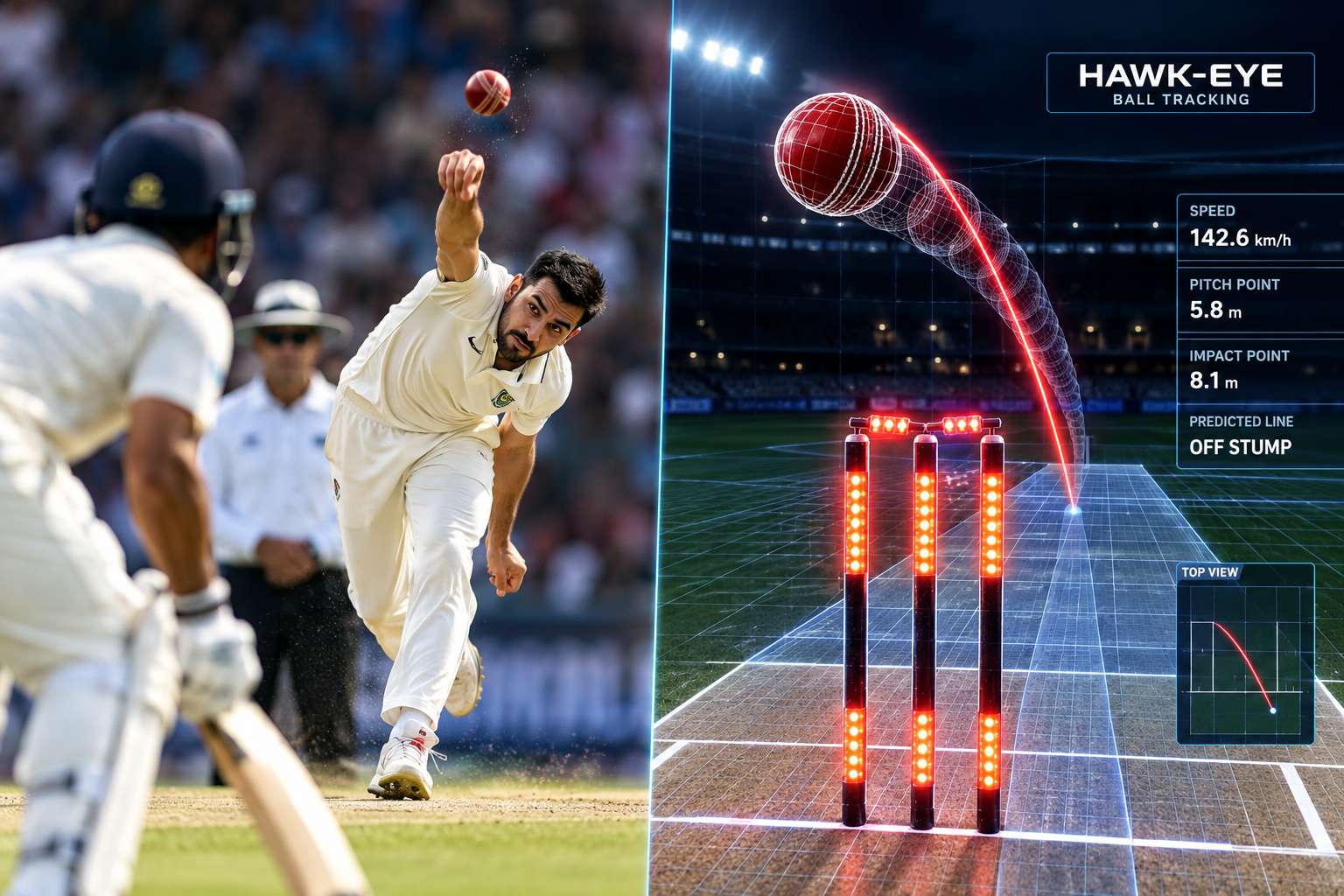
Hawk-Eye & Ball Tracking: Predicting the Future Path
Whenever an LBW (Leg Before Wicket) decision is reviewed, television broadcasts display an animated virtual line tracing where the ball would have travelled if the batsman's pad hadn't been in the way.
How It Actually Works:
- 6 to 10 High-Speed Cameras: Placed around the stadium roof and perimeter, filming the pitch from multiple angles at approximately 340 frames per second.
- 3D Triangulation: As the ball travels, the software identifies the spherical shape of the ball across all camera angles simultaneously to calculate its exact X, Y, and Z position in 3D space.
- Physics-Based Trajectory Prediction: By analyzing the ball’s speed, angle of release, pitch bounce point, and swing, the system uses physical laws (gravity, air drag, surface friction) to project the unhindered flight path toward the stumps.
UltraEdge & Snickometer: Seeing What the Ear Misses
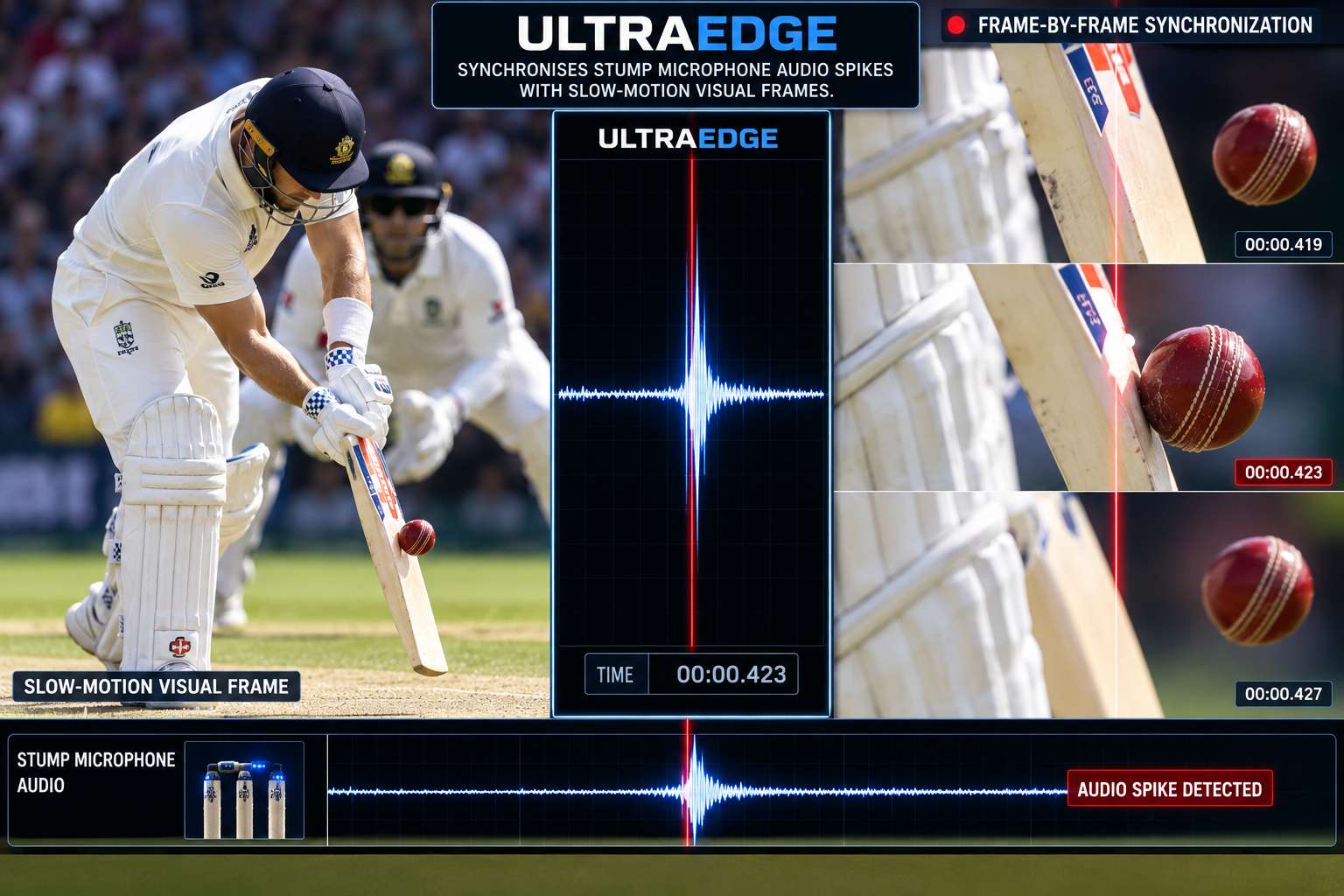
Did the ball nick the bat, or did it merely graze the batsman’s shirt or thigh pad? When the visual camera replay is too close to tell, third umpires consult UltraEdge.
- Stump Microphones: Highly sensitive directional microphones embedded inside the middle stump capture low-level audio frequencies on the pitch.
- Oscilloscope Waveforms: The system isolates sounds into visual sound waves. A dull brush against cloth or leather pad creates a smooth, low-frequency wave. But hard contact between a rigid willow bat and a hard leather ball creates a sharp, immediate frequency spike.
- Frame-by-Frame Synchronization: The sound spikes are calibrated frame-by-frame with high-speed video so the umpire can see whether the sound spike lines up precisely with the ball passing the edge of the bat.
Zing Wickets & LED Bails: The Millisecond Dislodge Detector
In tight run-outs and stumping appeals, determining the exact millisecond when the bails are broken used to require guesswork from blurry TV frames.
- Microprocessor Circuits: Invented in Australia by Zing Wickets, both the bails and stumps contain low-voltage microprocessors and miniature radio transmitters.
- 1/1000th of a Second Trigger: The moment both spigots of the bail break contact with the stump grooves, an electrical circuit breaks. Within 1 millisecond, high-intensity red LEDs flash.
- Run-Out Precision: The umpire simply freezes the video at the exact first frame the LED lights up and checks if the batsman’s bat is safely behind the popping crease line.
Smart Balls & Microchip Sensors
One of the newest innovations in modern cricket is the Smart Ball, developed by Kookaburra and tech firm Sportable.
- Embedded Microchip: A tiny, shock-resistant sensor is embedded in the central cork core of the ball without altering its weight or bounce.
- Real-Time Telemetry: Radio frequency receivers around the boundary track the ball’s velocity at hand release, velocity pre-bounce, and velocity post-bounce.
- Revolutions Per Minute (RPM): The chip measures how fast spin bowlers are rotating the ball, showing viewers live revolutions per minute and drift angles.
Automated Front-Foot No-Ball Detection
Historically, on-field umpires had to watch the bowler's front foot landing line while simultaneously looking up to follow a 140 km/h delivery at the other end.
Today, dedicated side-on high-speed cameras stream video directly to the third umpire. Automated computer vision overlays detect the exact moment the bowler’s front foot lands. If no part of the foot is behind the crease, an automated audio chime alerts the on-field umpire within two seconds, ensuring fair bowling without stopping the game.

Frequently Asked Questions
Is Hawk-Eye 100% accurate in cricket?
Hawk-Eye is extremely accurate (typically within 5 mm), but no optical tracking system is 100% absolute. This is why the "Umpire's Call" rule exists: to account for slight mathematical tolerances when projecting where the ball will hit the stumps.
How do LED Zing bails know when to light up?
The bails and stumps share a low-voltage electrical circuit. When both ends of the bail lift out of the stump grooves, the circuit breaks, and microprocessors trigger the red flashing LEDs within 1/1000th of a second.
Can a bowler's speed gun be fooled?
Modern cricket speed guns use Doppler Radar technology, measuring frequency shifts of radio waves reflected off the ball at release. As long as the radar beam points directly down the pitch line, speed readings are accurate to within 1 km/h.
